

One EV Exported for Every Two Sold at Home: Reading China's 2026 Export Data
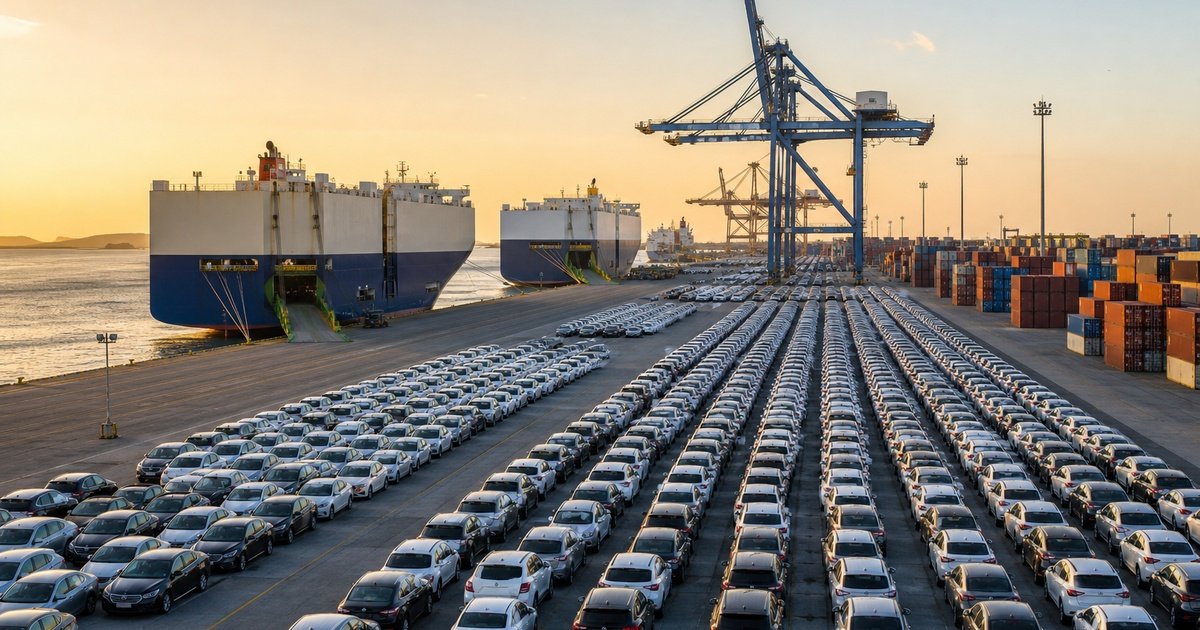
Something changed in China's car business this year, and the change matters more to importers than to anyone else. Sales inside China fell about 12 percent in the first seven months of 2026, while 2.4 million pure-electric and plug-in hybrid cars were exported from the country in the first half alone — more than twice as many as a year earlier, according to China's customs administration. The home market is no longer the engine. Exports are.
The home market cooled while the export lane heated up
The clearest number is the ratio. In July 2026 about 540,000 electric cars left China, a monthly record, against roughly 980,000 sold domestically, according to Benchmark Mineral Intelligence. That is one exported for every two sold at home; a year earlier the ratio was one for every five. Outside China, Europe and North America, electric car sales nearly doubled to 1.7 million units in the first seven months of 2026, and Chinese brands supplied about half of them, up from roughly a quarter in 2023.
The plug-in hybrid quietly took the lead
The export mix has tilted toward vehicles that do not depend on a charging network. In the first half of 2025, Chinese plug-in hybrid exports tripled year on year while battery-electric exports grew about 40 percent, based on association data cited by the trade press, and the gap has not closed since. Two policy facts explain part of it: the European Union's countervailing duties of up to 35.3 percent apply to battery-electric cars and not to plug-in hybrids, and the export licence requirement China introduced for pure-electric passenger cars on 1 January 2026 does not cover hybrids. Our own list reads the same way — Seal 05 DM-i and the second-generation Qin PLUS DM-i on the plug-in side, the Corolla, Corolla Cross, RAV4 and Frontlander hybrids on the no-plug side, and a handful of pure-electric SUVs rather than a fleet of them.
Three markets, three different doors
Destination rules now decide as much as product does.
- Thailand — carmakers that took subsidies must build two cars locally for every one imported, rising to three next year.
- Brazil — the import tax on electric cars has been raised to the same level that petrol cars pay.
- The Gulf — no local-content conditions, low barriers, and growing appetite for Chinese technology.
- The European Union — additional duties of up to 35.3 percent on battery-electric cars, with plug-in hybrids outside that net.
The overhang nobody prices at order time
More than a million electric cars shipped from China in the past eighteen months had not found a buyer, and only about two thirds of this year's exports had reached one, according to the International Energy Agency. For a distributor that arithmetic shows up later as discounting, incentives and pressure on residual values when the market clears stock. Landed cost is the number importers negotiate; resale is the number that decides whether the second container gets ordered.
What to change in your sourcing plan
- Choose the powertrain by the charging reality of the end customer, not by the trend in the headlines.
- Check whether your market treats plug-in hybrids like electric cars for duty or registration, because the difference is now material.
- Budget lead time for pure-electric orders specifically, since the licensing step has no equivalent on hybrid orders.
- Model residual value over three years, not only the invoice on arrival.
- Keep an entry-level petrol tier in the mix for buyers who are ready for neither.
Tell us the destination market and how your customer actually drives, and we will tell you which powertrain our current list supports best for it.