Introduction: The 2026 EV Paradigm Shift
The global automotive industry has entered a transformative phase in 2026, characterized by shifting innovation centers, aggressive export strategies, and deep structural adjustments. According to recent market analyses, global New Energy Vehicle (NEV) sales reached approximately 10.25 million units in the first half of 2026, marking a 14% year-over-year increase. For B2B buyers, traders, and importers, understanding these macroeconomic shifts is critical to navigating the evolving supply chains and trade regulations.
Innovation Leadership: China and Germany Lead the Pack
The traditional hierarchy of automotive innovation is being rewritten. The 2026 Global Electric Vehicle Innovation Report by the German Automotive Management Center reveals that the global EV innovation landscape has formed a dual-leadership structure between China and Germany. Evaluating 867 mass-production innovations across 36 vehicle groups, the report highlights a significant milestone: Chinese automakers have reached the top of the global rankings for the first time since the evaluation began in 2005.
In 2026, Chinese automakers account for 32.4% of the total innovation score, narrowly edging out Germany at 31.9%. This 0.5 percentage point gap underscores a fierce technological arms race, moving far beyond simple electrification into software-defined vehicles and advanced autonomous driving systems. The market competition has transitioned from early single-pole leadership to a contest between traditional large-scale automakers leveraging multi-brand strategies and Chinese enterprises executing rapid technological iterations.
- Geely Group: Secured the first place in the EV-specific innovation index with a score exceeding 200, driven by its multi-brand layout and industry-leading 450kW ultra-fast charging technology.
- BYD: Ranked first in the comprehensive innovation index, surpassing Volkswagen and Mercedes-Benz, largely due to its pioneering deployment of Level 2+ high-speed navigation assisted driving in compact cars and extensive patent layouts.
- Volkswagen & Mercedes-Benz: Demonstrated strong resilience, with VW ranking second in the comprehensive index and Mercedes maintaining its lead in the luxury segment.
- Tesla & US Automakers: Tesla dropped to sixth in the EV-specific index, reflecting a broader weakening of innovation momentum among US automakers.
The Export Surge: Navigating Tariffs and Emerging Markets
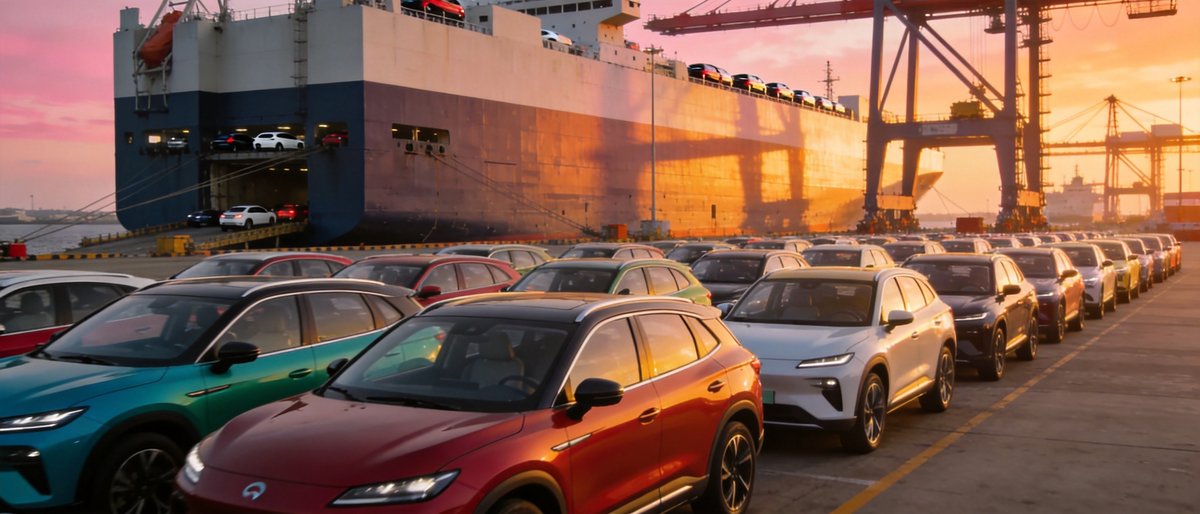
While domestic markets in mature regions face saturation and policy transitions, export channels have become the primary growth engine for Chinese NEVs. In H1 2026, China's NEV exports accounted for approximately 31% of total sales, a sharp increase from 15% in H1 2025, with cumulative export volumes surging nearly 120% year-over-year.
This export explosion is driven by three main factors: a low base effect from the previous year's EU anti-subsidy probe, a rush to export ahead of new tariff implementations, and enhanced product competitiveness in emerging markets. Q1 2026 data shows China exported 650,000 units (up 30%), with Mexico, Brazil, and Southeast Asia emerging as the top three markets.
Trade Implications and Tariff Strategies
For global importers, the regulatory environment remains a critical factor. The EU's countervailing duties, ranging from 17% to 38%, have been active since February 2026. In response, Chinese OEMs are accelerating localized production. Notably, BYD's Hungary plant is slated for late 2026 to bypass these tariffs. Furthermore, the average battery capacity for vehicles from January to May reached 68.4 kWh (up 34% YoY). This growth is driven by a consumption structure upgrade, with trade-in policies steering demand toward larger B- and C-class models. For B2B importers, this signals a shift toward higher-margin, premium EV segments in overseas markets.
Strategic Realignment: Universal Platforms and Supply Chain Integration
Looking ahead, the structural foundation of global auto trade is shifting towards modularity and vertical integration. Frost & Sullivan's latest analysis forecasts that global Battery Electric Vehicle (BEV) sales will grow from 17.8 million units in 2024 to approximately 32.6 million units by 2031. Growth is expected to accelerate beyond 2027 as OEMs introduce lower-cost EVs and governments tighten emissions regulations.
To achieve affordability and manufacturing efficiency, global OEMs are accelerating the shift to universal EV platforms. This strategy supports multiple vehicle segments and battery chemistries, significantly reducing development costs. Furthermore, manufacturers are strengthening supply chains through greater vertical integration and localized manufacturing, expanding investments in ultra-fast charging infrastructure, and exploring next-generation battery technologies like sodium-ion and solid-state batteries.
Regional Dynamics: What This Means for Global Auto Trade
The Q1 2026 regional data underscores divergent strategies that B2B traders must monitor:
- Korea: Battery localization is paying off. The Battery Big 3 are operationalizing plants in North America, ensuring IRA compliance and mitigating FEOC transition risks through 2026. Hyundai's Georgia plant and strong hybrid exports to Europe highlight a balanced approach.
- Japan: Maintaining hybrid dominance with 340,000 hybrid sales (48% market share) in Q1. Toyota's solid-state prototype road testing and the Honda-Nissan EV platform integration signal a cautious but strategic pivot.
- United States: The IRA FEOC implementation means battery components with Chinese entities lose credits, benefiting Korean battery makers. Tesla's Model 2 prototype and narrowing EV losses for GM and Ford indicate a maturing, albeit highly regulated, domestic market.
- Europe: Facing severe CO2 penalty pressures, with most automakers missing Q1 targets and facing billions in fines. This regulatory squeeze may increase Europe's reliance on imported, cost-effective EVs and battery components, provided they can navigate the tariff landscape.
Conclusion: Adapting B2B Strategies for the Next Growth Phase
The 2026 automotive landscape is defined by the dual forces of Chinese technological ascendancy and the global OEMs' strategic pivot toward modular, cost-efficient platforms. For international B2B buyers and traders, success in this environment requires agility. Sourcing strategies must account for regional tariff walls, such as the EU's countervailing duties and the US IRA FEOC rules, while capitalizing on the surging competitiveness of Chinese NEVs in emerging markets. As the industry transitions from policy-driven adoption to market-driven maturity, those who align their supply chains with the new realities of universal platforms and localized battery production will secure a distinct competitive advantage in the global auto trade.