

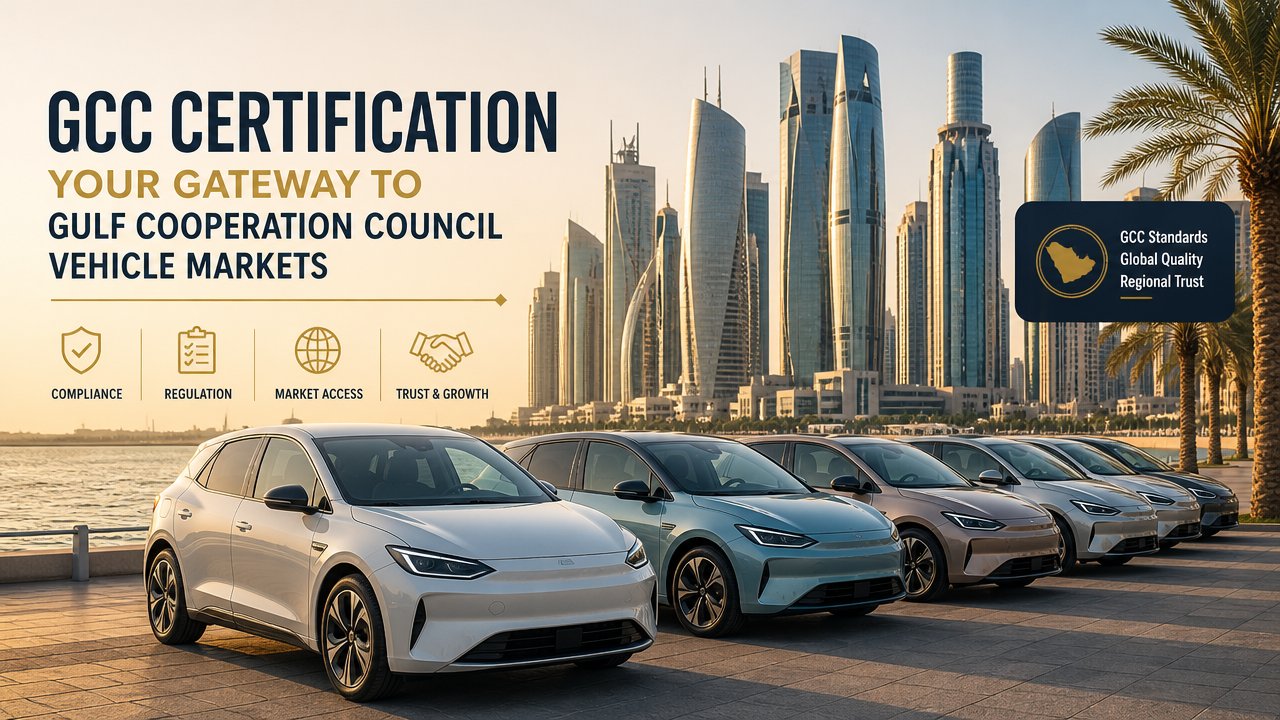
GCC Certification: The Passport Every Vehicle Needs to Enter the Gulf Market
The Gulf Cooperation Council states remain one of the world's fastest-growing regions for vehicle imports, and demand for electric and compact models is rising sharply. But unlike many markets, entry is not simply a matter of finding a buyer and booking a ship. Every four-wheeled vehicle sold across the GCC must hold a valid conformity certificate issued under the GSO scheme - the technical passport of the Gulf market. For importers, understanding this requirement early is the difference between a fast launch and a stalled shipment.
What GCC Certification Actually Is
The GSO certification scheme has been in force since 1 January 2005 and is operated by the Gulf Standardization Organization in the name of the member states - Bahrain, Kuwait, Oman, Qatar, Saudi Arabia and the United Arab Emirates. Vehicles covered by the scheme require a Gulf conformity certificate, and an approved certificate is recognised across all member states rather than only in the country of first entry. In practice this means a single, verified certification opens the entire Gulf region. The framework is not static: from 1 January 2026, new vehicle types submitted for approval in the UAE must also meet Euro 6b emission limits, so certification files have to be kept current as standards tighten.
Why Certified Models Win the Race
Certification is a manufacturer-level process covering technical regulations, safety equipment, emissions and conformity documentation. A model that has not been certified cannot be legally imported and sold - and the work needed to obtain a certificate takes time, money and engineering involvement. Importers who select models that already hold GCC certification bypass that queue entirely: they can quote, order and ship in a single cycle, while competitors wait for a compliance file to be completed. This is why, across the Gulf and in neighbouring markets such as Jordan, buyers increasingly open a conversation by asking which models are already GCC certified. Certification has become a purchasing criterion, not just a customs formality.
A Concrete Example: the Geely Xingyuan
The Geely Xingyuan - also marketed as the Geely EX2 and sold in some channels under the Geome Xingyuan name - is a case in point. This compact five-door electric hatchback is certified with GCC, meeting the requirements for entry to the Gulf market, and it is one of the best-selling electric hatchbacks in its home market. On paper it fits Gulf city use closely: CLTC range of 310 to 410 km depending on version, a 40 kWh class lithium iron phosphate (LFP) battery, a rear-mounted electric motor, fast charging in well under an hour, and a footprint of roughly 4.1 metres that suits dense urban traffic and parking. For fleet operators, ride-hailing platforms and first-time EV buyers, that combination of certification, range and size is precisely what the market has been missing.
What Importers Should Prepare
Start by verifying that the specific model and version you intend to import is covered by a valid GCC certificate - certification applies to the approved configuration, not to a nameplate in general. Check the emission standard applicable in your first market, particularly in the UAE where Euro 6b now applies to new vehicle types. Confirm that documentation will be supplied in Arabic where required, and that air-conditioning and thermal management specifications suit Gulf summer conditions, since cooling performance shapes buyer satisfaction more than range figures in this climate. Finally, plan the commercial structure - letters of credit, inspection and shipping documents - in parallel with certification checks, so that the moment your model is confirmed as compliant, the order can move.
Key Takeaways
- Every four-wheeled vehicle sold in the GCC needs a conformity certificate under the GSO scheme.
- An approved certificate is valid across all six member states, not just the country of import.
- GCC certification is now a purchasing criterion - certified models reach buyers months faster.
- Emissions rules keep tightening: Euro 6b applies to new vehicle types in the UAE from 1 January 2026.
- Compact certified EVs such as the Geely Xingyuan (EX2) fit Gulf urban demand directly.
Looking for GCC-certified vehicles? JINGSUN supplies Gulf-ready models with complete conformity documentation, inspection and shipping support - from inquiry to delivery.