

Four Gateways, Four Different Deals: How a Pickup Point Changes Your Import Plan
Dealers spend most of a sourcing conversation on the model. The pickup point deserves at least as much attention, because it decides transit time, the document set, and how small your first order is allowed to be. Our current list leaves China through three sea gateways, one overland border crossing and a group of inland depots, and the differences are practical rather than cosmetic.
The sea gateways: Nansha, Ningbo and Shanghai
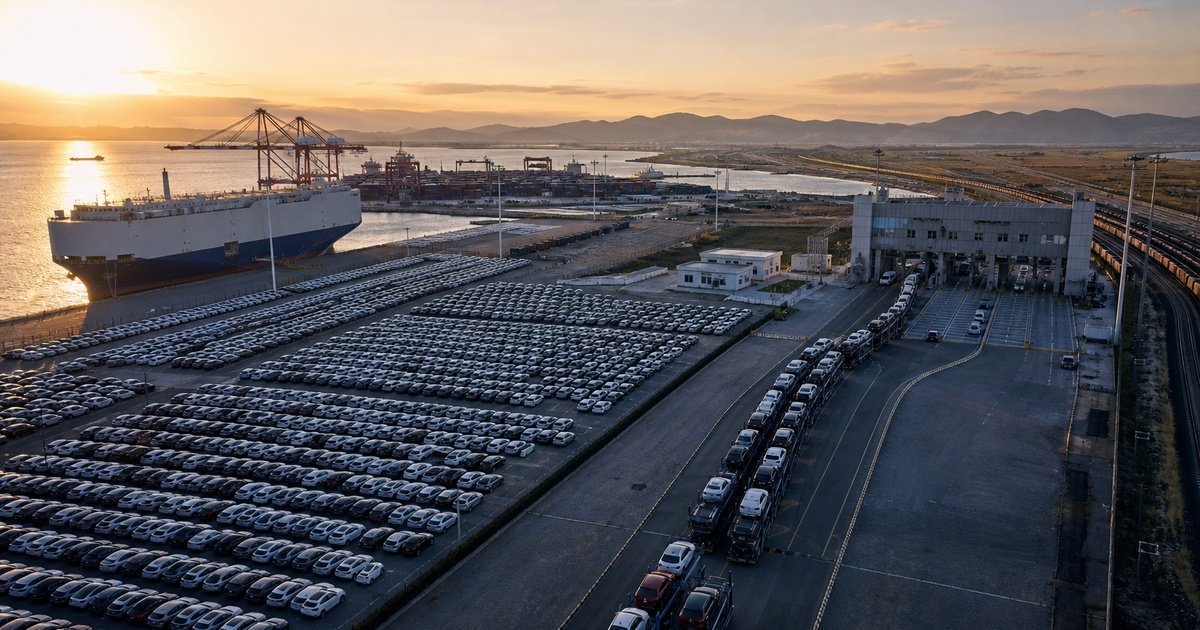
Nansha in southern China is our main exit for the models we quote most into Africa, the Gulf and Latin America; the MG5, the Rui Lan models and the Trumpchi GS3 are all offered from there. Ningbo handles the Kia side of the list, including the Stonic, Seltos and K3, and Shanghai is where the Volkswagen T-Roc 300TSI leaves from. All three load both container and RoRo, so the same car can travel two ways and that choice usually moves the total landed cost more than the model choice does.
The overland route: Khorgos
Khorgos on the Kazakhstan border is our land exit, and for Central Asia it is the fastest option because the vehicle never goes to sea. The Toyota Corolla and the top MG5 trim are offered from there, and the Kia models can be routed overland as an alternative to Ningbo. Transit is measured in days rather than weeks, which matters to a dealer restocking a showroom. The trade-off is geography: overland only makes sense if your market sits on the corridor.
The inland depots: East District, Xiangtan and Xiaobei
Not every unit starts at a port. The Geely Binyue L range is quoted from the East District, Xiangtan and Xiaobei depots, and the Volkswagen Tharu and Passat are handled through East District. These are consolidation points rather than loading ports, so a car may complete a first inland leg before it ever reaches a vessel. That is normal, but it adds a step that should appear in your schedule, so ask which legs are included before you commit to a delivery date.
What the pickup point changes for a first order
- How small the first order can be. Some lines carry minimum quantities and free-shipping terms at the gateway; others are quoted per unit. Those terms travel with the model, not with the yard.
- Whether you collect or we deliver. Several models are quoted as self-collection at the gateway, while others include freight to an agreed point. Both are normal, and they are not interchangeable.
- Documents. Sea and land exits produce different files, and an inland leg adds a step you must be able to document if you claim the route in your own customs paperwork.
- Transit time. The same model can be days or several weeks away depending on the exit, and that decides whether you can promise a customer a date.
How to use this when you ask for a quote
- Name your destination port or border crossing first; the gateway follows from it.
- Ask whether the unit is in stock for immediate release or quoted as a forward order.
- Ask which inland legs are included and which are not.
- Ask for the licence and document set that applies to that specific unit, because it is not identical across brands.
What we do not publish, and why
Terms at each gateway move with freight rates, vessel space and batch size. We quote them per unit against a real destination instead of publishing a list that would be out of date before it was read — which is also why our public pages carry no prices at all.
Send us the destination and the models you are considering, and we will tell you which gateway fits, what is in stock now, and what the file looks like.