

China's Used Car Exports Surge 38% in 2026: What Global Buyers Need to Know
China's used car export market is experiencing an unprecedented boom in 2026, with year-on-year growth reaching 38% in the first half of the year. For international B2B buyers and auto dealers across Africa, the Middle East, Southeast Asia, and Latin America, this presents a golden window of opportunity to source high-quality vehicles at competitive prices.
The Numbers Behind the Boom
According to the latest data from China's Ministry of Commerce, over 450,000 used vehicles were exported from China in the first six months of 2026. New energy vehicles (NEVs) account for an increasing share, now representing 28% of total exports, up from 18% in 2025. Traditional fuel vehicles still dominate at 72%, with popular models from Volkswagen, Toyota, Geely, and BYD leading the pack.
Key destination markets include Algeria (+52% YoY), Russia (+31%), Cambodia (+44%), and Rwanda (+67%). The Middle East and African markets combined now account for over 60% of China's total used car export volume.
Why Chinese Used Cars Are Winning Globally
1. Unbeatable Price-to-Quality Ratio. Chinese used cars typically sell at 30-50% below equivalent models in Western markets. A 2023 Volkswagen Tiguan L with under 100,000 km can be sourced for as low as $11,000 FOB, compared to $22,000+ for a comparable unit from Europe.
2. Massive Inventory Depth. With over 300 million vehicles on Chinese roads, the domestic used car market is the world's largest. This deep supply pool means international buyers can source specific makes, models, and configurations in bulk with consistent quality standards.
3. Streamlined Export Infrastructure. Major export hubs in Guangzhou (Nansha), Ningbo, Tianjin, and Shanghai have developed specialized auto export processing zones. These facilities handle everything from vehicle inspection and reconditioning to customs clearance and container loading, significantly reducing buyer lead times.
4. NEV Advantage. China leads the world in EV production and adoption. International buyers can now access used electric vehicles like the BYD Yuan Up, NETA V, and Aion UT at prices 40-60% below new equivalents, with battery health typically above 90% for vehicles under 30,000 km.
Key Considerations for International Buyers
While the opportunity is significant, successful sourcing requires careful attention to several factors. Vehicle history verification through platforms like Chaboshi and Cheyipai provides transparent accident and maintenance records. Export documentation including the Vehicle Registration Certificate, export license, and bill of lading must be meticulously prepared. Buyers should also factor in destination-country import duties, which vary significantly by market - Algeria imposes approximately 35% on used vehicles, while Rwanda offers preferential rates for NEVs.
Shipping and Logistics
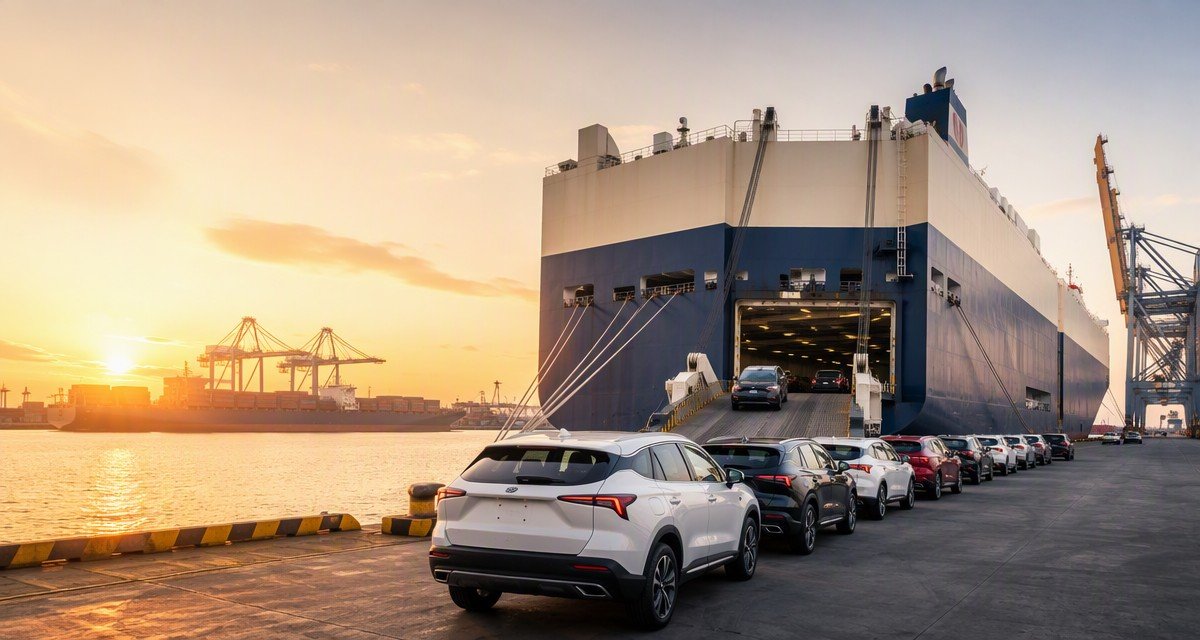
Most Chinese used car exports ship via roll-on/roll-off (RoRo) vessels or container shipping from major ports. Transit times range from 15-25 days to Middle Eastern ports, 20-30 days to East Africa, and 30-40 days to West Africa. Leading logistics providers now offer door-to-port and port-to-port services with real-time tracking, making the process increasingly transparent for international dealers.
Key Takeaways
- China's used car export market grew 38% YoY in H1 2026, with 450,000+ units shipped
- NEVs now represent 28% of export volume and growing rapidly
- African and Middle Eastern markets offer the strongest growth and margin potential
- Chinese used cars offer 30-50% cost savings versus equivalent Western-sourced vehicles
- Professional sourcing partners can handle inspection, documentation, and shipping end-to-end
Looking to source quality Chinese used vehicles for your market? Jingsun New Energy offers end-to-end procurement, inspection, and shipping services with a track record of 1,500+ vehicles exported across 15+ countries. Contact our trade team today to discuss your requirements.