

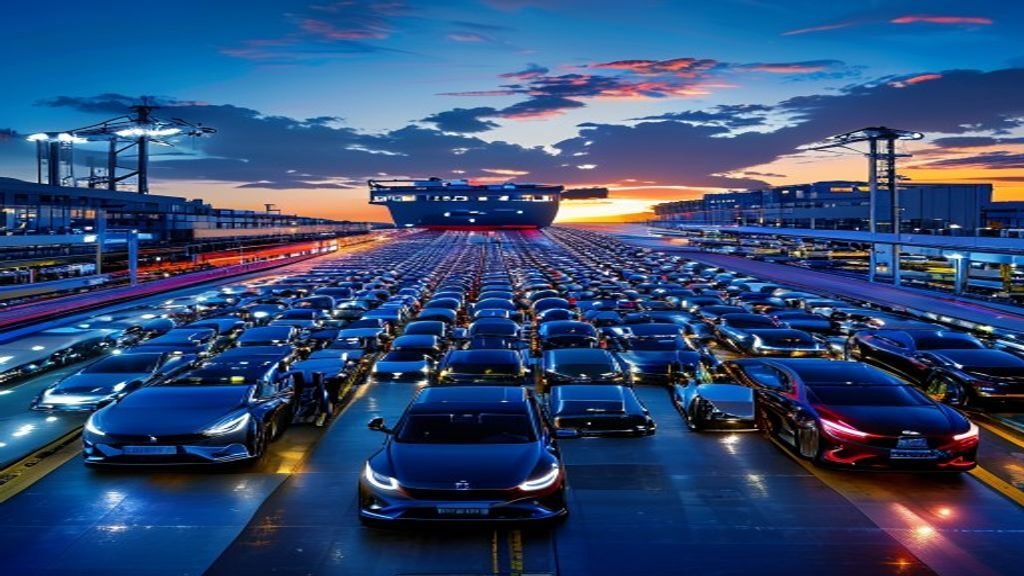
Introduction: A Historic Milestone in Global Auto Trade
The first half of 2026 has marked a definitive turning point in the global automotive landscape. For international B2B buyers, traders, and importers, the dynamics of sourcing vehicles from China are undergoing a profound structural shift. In June 2026, China’s total monthly auto exports surpassed the one-million-unit threshold for the first time in history. However, beneath this staggering volume lies a more complex narrative: the era of relentless price wars is officially over, supply chain costs are forcing price hikes, and the market is rapidly consolidating around high-value New Energy Vehicles (NEVs).
Record-Breaking Export Volumes Driven by NEV Dominance
According to data from the China Association of Automobile Manufacturers (CAAM), the export momentum in the first half of 2026 has been nothing short of extraordinary, providing a critical stabilizer amidst softening domestic demand.
- June Total Exports: Reached 1.037 million units, surging 75.1% year-on-year and 11.6% month-on-month.
- H1 Total Exports: Cumulative exports hit 5.096 million units, representing a robust 65.3% year-on-year increase.
- NEV Export Surge: In June alone, NEV exports reached 523,000 units, skyrocketing 160% compared to the same period last year.
- H1 NEV Contribution: NEVs accounted for over 46% of total H1 exports, with cumulative NEV exports reaching 2.355 million units (up 120% YoY).
Simultaneously, the domestic market is witnessing an accelerated transition. In June, the retail penetration rate of NEVs in China climbed to 62.8%, a 9.5 percentage-point jump from the previous year. Conversely, internal combustion engine (ICE) vehicle retail sales slumped by 39% year-on-year. For global importers, this signals that future procurement strategies must heavily pivot toward smart, green mobility solutions to remain competitive in their respective home markets.
The End of the Price War: Cost Pressures Force Industry-Wide Hikes
For the past three years, international buyers have benefited from aggressive price cuts as Chinese automakers fought for market share. That paradigm has officially shifted. In the first half of 2026, a wave of price hikes has swept through the industry, forcing manufacturers to reveal their "final cards."
From decisive price adjustments by Harmony Intelligent Mobility in March to simultaneous upward shifts by Tesla, NIO, GAC Aion, Avatr, and Zeekr in May, per-vehicle price increases have ranged from 2,100 to 20,000 RMB. According to the China Passenger Car Association (CPCA), the average price of new energy passenger vehicles in May 2026 reached 169,000 RMB, a year-on-year increase of 7,000 RMB.
Understanding the Cost Drivers
This dramatic reversal is not merely a margin-recovery tactic; it is a passive cost pass-through driven by global macroeconomic factors:
- AI Industry Competition: The global boom in artificial intelligence has triggered intense competition for chip and battery material production capacity.
- Raw Material Rebound: Lithium carbonate prices have returned to elevated levels.
- Component Upgrades: For example, the upcoming Li L6 features a battery capacity increase from 36.8kWh to 51kWh. Combined with rising memory costs and the integration of the Qualcomm 8797 chip, the per-vehicle production cost has increased by over 14,000 RMB.
Trade Implication: B2B buyers must recalibrate their financial models. The "race to the bottom" in pricing has ended. Future competition will focus on technological value, software ecosystems, and supply chain reliability rather than sheer cost reduction.
Market Consolidation: Domestic Brands Lead, Entry-Level EVs Cool
While the overall NEV narrative is bullish, a closer look at the domestic data reveals a structural fracture that impacts export product mixes. Domestic brands continue to dominate, capturing a 68.6% market share in June. However, their overall retail sales slipped 18% year-on-year, largely due to a severe cooling in the entry-level segment.
Wholesale sales of A00-class pure electric vehicles plunged 50% year-on-year in June to just 77,000 units, accounting for only 8% of the pure EV market. The hangover from subsidy rollbacks and weak purchasing power in lower-tier markets has made ultra-cheap micro EVs a bottleneck for expansion.
Trade Implication: International traders should be cautious when sourcing entry-level A00 EVs. The market is shifting toward mid-to-high-tier vehicles equipped with advanced features like L2 autonomous driving and premium smart cabins. Procurement strategies should prioritize quality and technological integration over ultra-low price points.
Global Trade Implications: Western Automakers Face Structural Crisis
The ascendancy of China’s NEV sector is occurring precisely as legacy automakers in Europe and the Americas face compounding crises. The previous business model of Western car production has been severely disrupted by geopolitical conflicts, energy costs, and supply chain vulnerabilities.
Volkswagen, for instance, is considering the closure of four factories and large-scale staff cuts, with approximately 100,000 jobs at risk. The German automaker's struggles are exacerbated by the loss of access to cheap energy, unsuccessful EV debuts in China, and new EU sanctions that inadvertently restrict access to essential chips from Chinese manufacturers like Yangzhou Yangjie Electronic Technology. Reports indicate that available chip stocks for the German auto industry may only last until the end of summer 2026.
Furthermore, global supply chain disruptions, including the closure of the Strait of Hormuz, have added immense logistical pressure. As a result, international legacy brands are increasingly forced to integrate Chinese R&D expertise and form local partnerships just to maintain a competitive edge in their global portfolios.
Conclusion: Strategic Procurement in a Maturing Market
The H1 2026 data paints a clear picture: China’s automotive industry is transitioning from a phase of aggressive, subsidy-driven expansion to one of mature, value-oriented competition. For international B2B buyers and importers, the takeaways are critical. The window for sourcing ultra-cheap, entry-level EVs is closing, and baseline procurement costs for high-quality NEVs are rising due to inescapable supply chain realities.
To succeed in this new era of global auto trade, buyers must secure long-term supply agreements, focus on technologically advanced NEV platforms, and adapt to a market where Chinese innovation dictates the global pace of automotive evolution.