

Record-Breaking Export Milestones in 2026
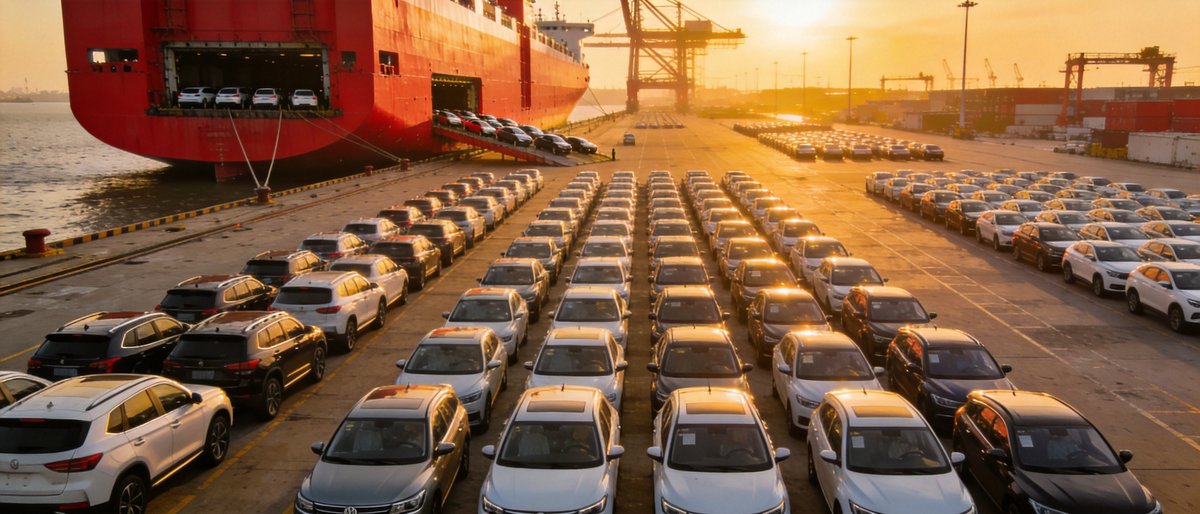
According to the China Association of Automobile Manufacturers (CAAM), China's automobile exports reached a historic milestone in June 2026, hitting 1.037 million units. This represents a massive 75.1% year-on-year increase and marks the first time monthly exports have surpassed the 1 million threshold. For the first half of 2026 (H1), cumulative auto exports reached 5.096 million units, surging 65.3% compared to the same period last year. Industry experts remain cautiously optimistic that the full-year export volume could break the 10 million mark.
The New Energy Vehicle (NEV) Export Engine
The exponential growth in exports is heavily driven by New Energy Vehicles. In June alone, NEV exports reached 523,000 units, skyrocketing by 160% year-on-year. Notably, for the first time, monthly NEV exports surpassed traditional internal combustion engine (ICE) vehicle exports.
Over the first six months, cumulative NEV exports totaled 2.355 million units, reflecting a staggering 122.3% year-on-year growth. This significantly outpaces the 35.5% growth rate of traditional fuel vehicle exports. Plug-in hybrid electric vehicles (PHEVs) are also showing immense momentum, with H1 exports reaching 922,000 units, up 136.3% year-on-year, indicating a strong global demand for versatile electrified powertrains.
Market Dynamics: Navigating the Three Divergences
CAAM highlighted that the Chinese auto market is currently experiencing three distinct divergences, which have profound implications for global B2B buyers and traders:
- Domestic Pressure vs. Export Boom: While domestic sales faced a 21.1% decline in H1, export growth has more than compensated for the shortfall, acting as the primary stabilizer for the industry.
- Passenger vs. Commercial Vehicles: Passenger car sales saw a slight decline of 6% in H1, whereas commercial vehicles grew by 8.3%, with heavy and medium trucks showing robust recovery.
- ICE Contraction vs. NEV Expansion: Traditional ICE vehicles are rapidly shrinking in the domestic market, with domestic ICE passenger car sales dropping 31.9% in H1. Conversely, NEV sales reached 7.446 million units in H1, achieving a 49.6% market penetration rate. In June, NEV penetration in domestic sales hit 58.5%, confirming NEVs as the mainstream product.
Tech Upgrades and Compliance: What Global Buyers Must Know
Beyond volume, the technological and regulatory landscape of Chinese auto exports is evolving rapidly. Global importers must align their procurement strategies with these advancements:
800V Architecture and Advanced Charging
The 800V high-voltage architecture is becoming the standard for premium pure electric vehicles. Recent models are demonstrating ultra-fast charging capabilities, such as adding 400km of range in just 10 minutes, with peak charging power reaching 400kW. This technological leap significantly reduces range anxiety and enhances the appeal of Chinese EVs in overseas markets.
End-to-End AI and Smart Cockpits
Chinese automakers are deploying local Vision-Language-Action (VLA) and Vision-Language Models (VLM) for autonomous driving. These systems enable proactive, instruction-free services, such as automatic rerouting in traffic and predictive cabin adjustments. For B2B buyers, this means offering end-users a highly advanced, software-defined vehicle experience.
Stringent Safety Standards and Global Compliance
China has introduced its strictest national safety standards, including the GB 47955-2026 for intelligent connected vehicles, which mandates L2-level driving assistance safety requirements effective January 2027. Key provisions include mandatory driver monitoring (hands-off warnings) and Event Data Recorders (EDR) for accident liability. Furthermore, new battery safety regulations mandate no fire or explosion during collisions and thermal runaway. Globally, Chinese exporters are also aligning with EU mandates, such as the new Driver Distraction Warning (ADDW) systems required for new vehicles. These rigorous standards ensure that exported vehicles meet top-tier international safety benchmarks.
Strategic Outlook for International Auto Traders
The Chinese government continues to support the sector through policies like the 15th Five-Year Plan carbon peak action, aiming to enhance the competitive edge of new energy and power battery industries. For international buyers, traders, and importers, the current landscape offers unprecedented opportunities. The combination of massive production scale, rapid technological iteration (like 800V charging and AI integration), and increasingly mature supply chains positions Chinese vehicles as highly competitive assets in the global market.
However, traders must remain vigilant regarding external uncertainties and shifting international trade policies. Diversifying sourcing portfolios to include high-growth segments like PHEVs and commercial NEVs, while ensuring strict compliance with evolving destination-country safety and cybersecurity regulations, will be key to maximizing ROI in the second half of 2026 and beyond.